A Look at Domestic Managers Across the Continent
Having explored the interconnectedness of players among the European leagues in a previous post, it's time to turn the focus to managers.
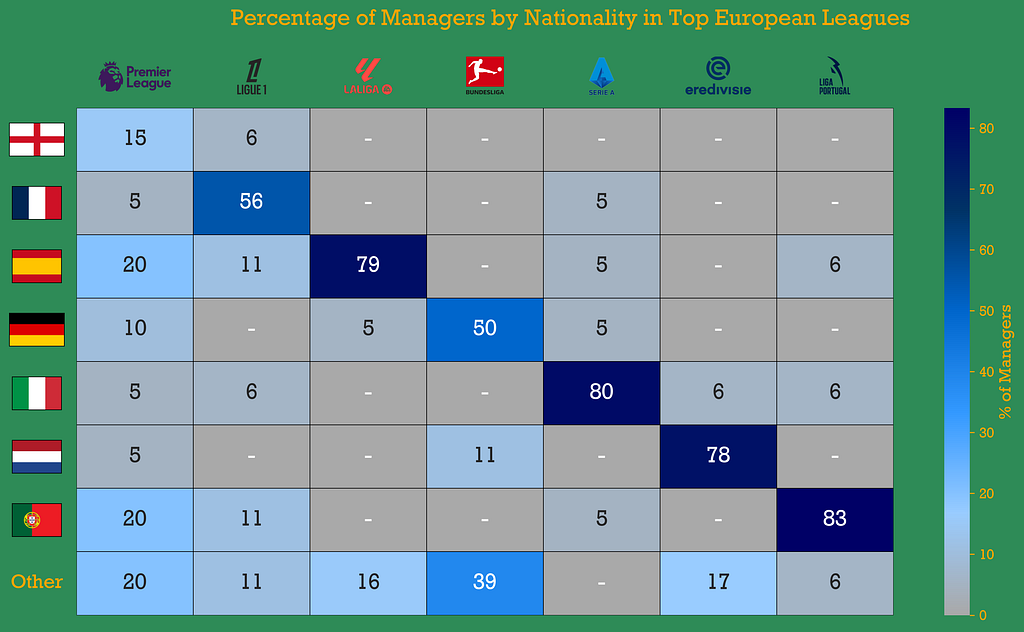
To analyse trends in managerial nationalities, I created a correlation matrix comparing the top seven European leagues (England, Spain, Germany, Italy, France, Portugal, and the Netherlands) with the most common nationalities represented in each. Most leagues show a strong homegrown preference, with Spaniards dominant in La Liga, Italians lead in Serie A, and so on. But one league bucks the trend: the Premier League. At the time of writing, Portuguese (20%) and Spanish (20%) managers actually outnumber English ones (15%). Earlier in the season, that figure had dipped as low as 5%.
The Premier League has often seen clusters of managers from specific regions dominating its touchlines. At one point in 2011, as many as 35% of Premier League managers were not only Scottish but specifically from Glasgow and its surrounding areas. More recently, until Julen Lopetegui was sacked earlier this season, 25% of Premier League managers were Spanish — namely Andoni Iraola (Bournemouth), Pep Guardiola (Man City), Mikel Arteta (Arsenal), and Unai Emery (Aston Villa). Remarkably, all of them except Guardiola come from Gipuzkoa, a small province in Spain's Basque Country.
This international flavour is one of the Premier League's great strengths. The presence of foreign managers has helped evolve the tactical landscape in England, bringing with it diverse philosophies, fresh training methodologies, and new ways of approaching the game. This trend reflects the Premier League's status not just as a domestic competition, but as a global product and one that naturally attracts the best minds from around the world.
Digging Deeper into Second Divisions
To understand whether similar patterns exist further down the football pyramid, I created a dot plot comparing the percentage of domestic managers in both the first and second divisions of each country. Each nationality is listed on the y-axis, with two dots representing the top (in gold) and second (in silver) tiers. As expected, most countries have a higher percentage of domestic managers in their second divisions. These clubs often rely on local knowledge, established networks, and traditional coaching pathways, which naturally favour homegrown appointments.

Once again, the English leagues stand apart. Not only does the Premier League have by far the lowest proportion of domestic managers among Europe's top flights, but the Championship, England's second tier, is also the most internationally managed second division on the continent. This doesn't necessarily indicate a concern, but it does suggest that English coaches face a competitive landscape. If anything, the presence of world-class foreign managers raises the bar, encouraging domestic talent to adapt, learn, and ultimately thrive in one of the most demanding football environments in the world.
The code for these plots and analysis can be found in my GitHub repository