The term "sleeping giant" is a familiar one in English football and is often used to describe clubs with historical stature, passionate fanbases, and untapped potential, yet stuck outside the Premier League. But while the phrase is widely used, it's rarely defined in measurable terms and this analysis sets out to change that. By combining data on average attendance, league position, and time spent outside the top flight, we attempt to quantify which clubs are truly the biggest sleeping giants in English football.
To begin, I displayed clubs' league position (2024/25) against the number of years they've been absent from the top tier in the scatter plot below. Even this simple visual begins to tell a story. Clubs like Bristol City and Oxford United appear in a prolonged slumber, having been away from the top division for decades. Oldham Athletic, now 77 places below the Premier League and in their 31st year outside it, emerge as one of the most deeply "asleep" clubs in the dataset.
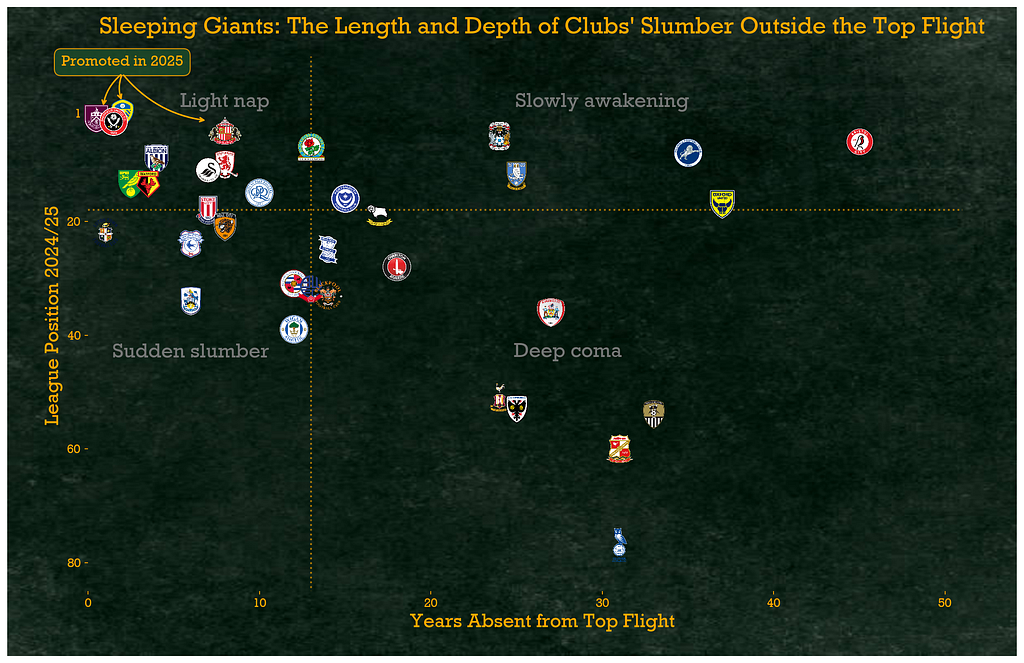
At the opposite end, Burnley sit at the very top-left of the scatter plot, a club recently relegated from the Premier League and finishing second in the Championship. Their short absence and strong performance means they're far from a deep sleeper.
Building the Sleeping Giant Index (SGI)
To bring more structure to the analysis, I developed the Sleeping Giant Index (SGI) as a single metric designed to capture a club's latent potential using three key components:
- Average attendance (as a proxy for fanbase size)
- Recent league position (current performance)
- Years outside the top flight (length of slumber)
Each factor was normalised for comparability, and the final SGI score was calculated as a weighted blend, giving equal importance to fanbase and the "size of sleep." The latter includes both the number of years since top-flight football and how far down the pyramid a club has fallen.
The bar chart below ranks clubs by their SGI scores. Sunderland tops the list, boasting consistently strong attendances despite years out of the top flight. Bristol City ranks a close second as their 45-year exile from the top flight, combined with a solid fanbase, highlights just how overdue their return might be. At the other end of the scale, Luton Town ranks lowest due to their limited stadium capacity and recent top-flight stint, which shortens their "sleep."
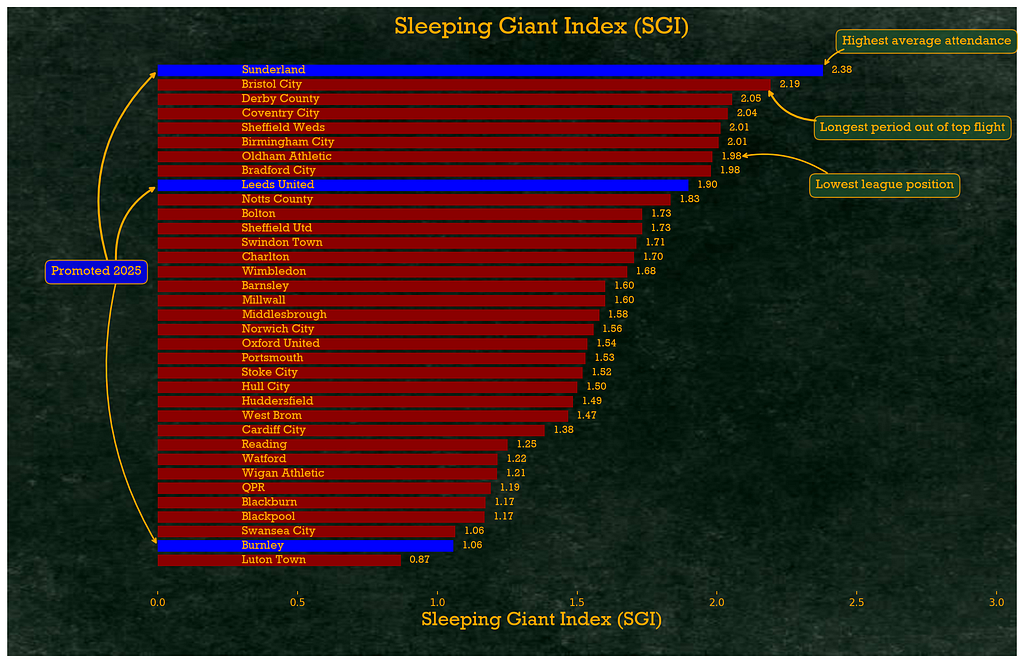
Interestingly, while most clubs in the SGI top ten currently play in the Championship, several teams in the third and fourth tiers like Birmingham, Bradford and Notts County also rank surprisingly high, driven by the size and loyalty of their fanbases.
Why SGI Matters
The SGI doesn't claim to predict promotion or future success, neither does it account for factors like ownership, infrastructure, or financial health. But what it does offer is a structured lens through which to view potential. It brings together scale (fanbase), stagnation (years outside the top flight), and success (league position) into one narrative-driven metric. For fans, analysts, and investors alike, SGI provides a way to move beyond nostalgia and identify value. It highlights loyal supporter bases, historic underachievement, and the kinds of clubs that, with the right leadership and a bit of luck, could shake up the English football landscape once again.
Sunderland's loyalty. Bristol City's long exile. Oldham's slow decline. These stories aren't just about history, they're about possibility. And in a game driven by momentum and money, identifying a sleeping giant before it wakes up might just be the smartest move of all.