In a previous post, I introduced Players in Common — an interactive web app that challenges football fans to name players who've represented two different clubs across Europe's top five leagues. While building and analyzing the underlying data which powers the game, I uncovered some surprising patterns in player movement across top-flight clubs over the past few decades.
Italy's Unique Football Web
One of the most striking insights is just how dominant Italian clubs are when it comes to shared player history. Of the top 100 club combinations with the most players in common, a staggering 82 involve two Serie A clubs — including all of the top 22 in the table below.
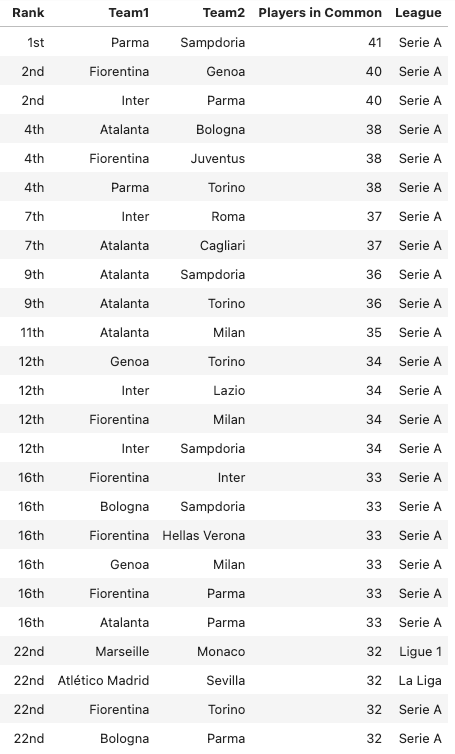
This reveals a unique culture within Italian football: player movement between Serie A clubs is far more frequent than in other major leagues. The table above shows how iconic Italian clubs have long-standing traditions of exchanging experienced players. This interconnectedness reflects a league where rivalries don't prevent transfers, and domestic experience is highly valued.
Club Combinations: Geography and Consistency Matter
The bar chart below shows the club pairings with the most shared players in each of the top five leagues. Two patterns stand out:
- Consistent top-flight clubs dominate these rankings. Clubs that avoid relegation have more seasons in the top tier, naturally creating more chances for shared players.
- Geography matters. Proximity seems to encourage movement, especially between clubs where rivalries are less intense.
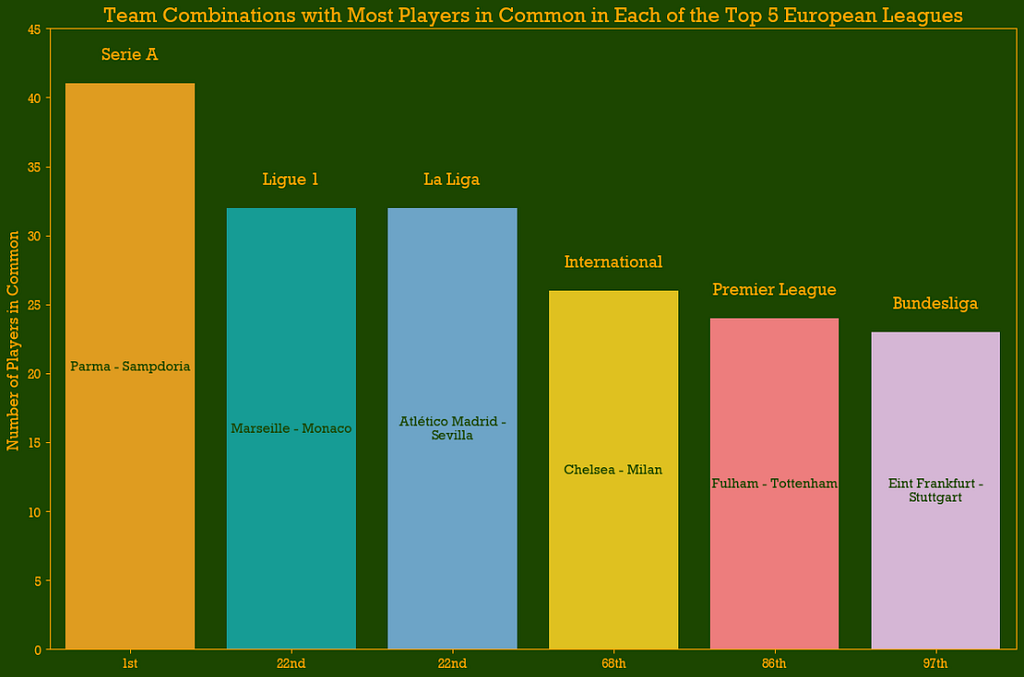
Some stories stand out. Fulham and Tottenham top the Premier League list with 24 shared players — more than any other English pairing. This is notable given Fulham's three relegations since 1992. However, the short distance between Craven Cottage and Tottenham, coupled with a relatively neutral rivalry, makes this frequent player exchange understandable.
Geographic proximity appears influential elsewhere too. Examples include:
- Parma and Sampdoria (Northern Italy)
- Marseille and Monaco (Southern France)
- Frankfurt and Stuttgart (Southwestern Germany)
These regional links highlight how location plays a powerful role in shaping player movement, beyond just league structure or club stature.
Veterans and Journeymen
Digging into individual player careers, the data also uncovers a contrast between longevity and variety. Players like Francesco Totti and Ryan Giggs spent their entire 20+ year careers at one club — Roma and Manchester United respectively.
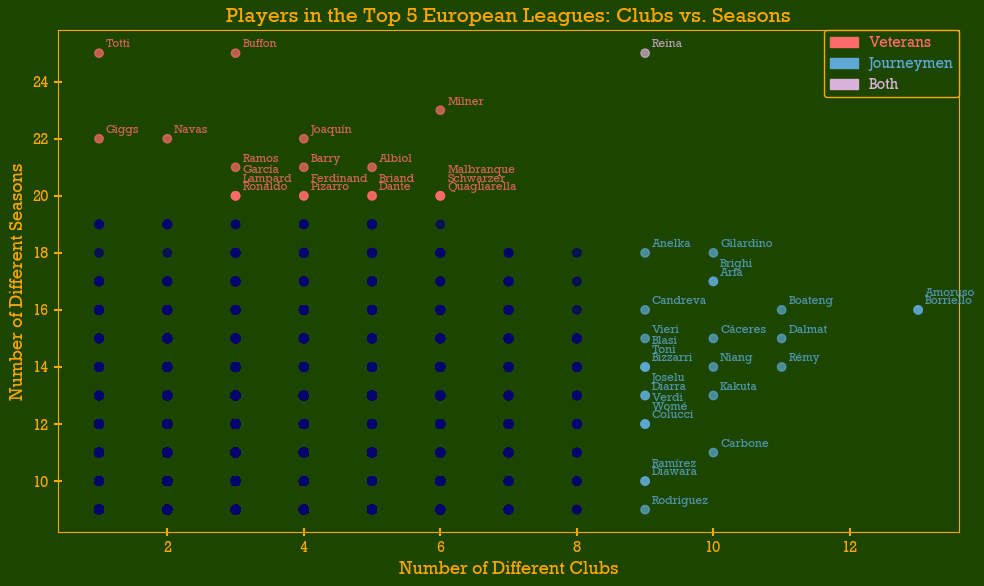
But at the other end of the spectrum are Italian journeymen like Nicola Amoruso and Marco Borriello. Amoruso turned out for 13 Serie A teams, while Borriello played for 13 top-flight clubs — 12 in Italy, plus a brief two-match stint at West Ham. On the scatter plot below, they appear on the far right, highlighted in light blue, showcasing how Serie A fosters a culture of internal movement rarely seen elsewhere.
In summary, the data highlights how Serie A stands out in terms of inter-club player movement, underlining its tight-knit football culture. While geographic proximity influences transfers across all leagues, the surprising Fulham-Spurs link and the phenomenon of Italian journeymen offer a fresh perspective on the intricate web of player connections that shape European football history.
This analysis focuses on seasons from 1992 onwards, meaning it doesn't include earlier generations of players who also moved widely between clubs. A more historical dataset would broaden the perspective, but even within this 30-year window, the trends are clear and compelling.
Check out the full code behind these insights in my GitHub. Put your European football knowledge to the test with Players in Common — my interactive web app.