Exploring FIFA Men's Rankings Through Multiple Linear Regression
FIFA releases its Men's World Rankings every couple of months, calculated using the Elo rating system, which aims to measure how well a nation's men's football team is performing on the international stage. In this project, I set out to explore a simple question:
Are there other factors, both sporting and societal, that can help explain a nation's position in the FIFA Men's Rankings?
Football may be the world's most popular sport, but its success isn't equally distributed. Some countries consistently dominate, while others, despite their size or economic strength, struggle to leave a mark. To understand why, I looked beyond football results and explored whether performance in other sports like basketball and women's football, as well as broader indicators like population and GDP, might offer clues about national football success.
The Data
To investigate, I pulled the most recent data from multiple sources:
- FIFA for men's and women's football rankings
- FIBA for international basketball rankings
- Worldometer for GDP and population rankings
After cleaning and merging the datasets, I ended up with a consistent sample of 128 countries — diverse in size, geography, and economic status — all with complete data across these metrics.
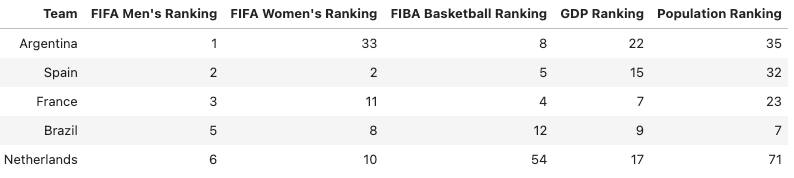
To simplify comparisons and minimize skew from large numerical gaps, I used ranking positions instead of raw values like GDP or population size. This approach allows for a more balanced and uniform comparison between countries.
Initial Insights: Correlation Analysis
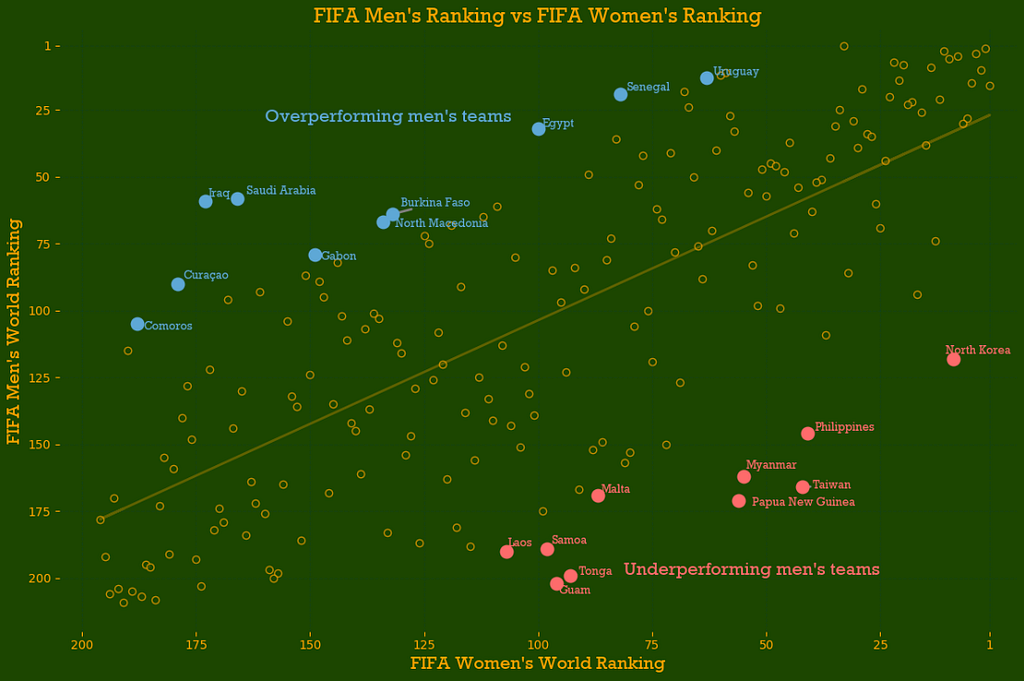
A quick correlation analysis showed the strongest relationship was between men's and women's FIFA rankings, with a correlation coefficient of 0.71. That makes intuitive sense: countries that invest in football infrastructure tend to see benefits across both genders, sharing facilities, coaches, and national development programs.
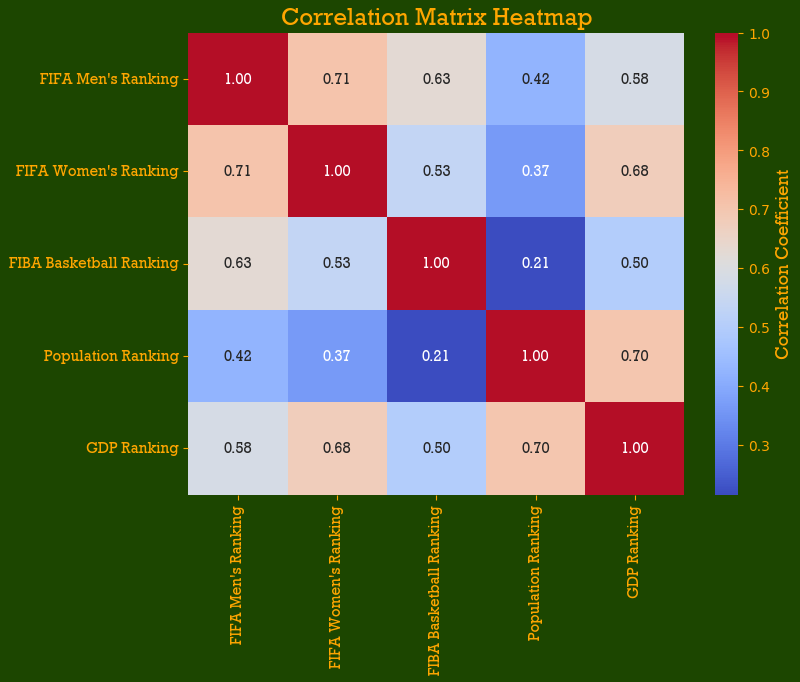
Other patterns were less expected. For instance, GDP ranking correlated more with women's football than it did with men's football or basketball. This suggests that economic power doesn't always translate evenly across different sports. Success in women's football is more closely tied with a nation's economic wealth whilst men's football and basketball it seems can still thrive in lower-income nations.
Outliers: Underperformers and Overperformers
In the graphs below I took a look at countries which deviated significantly from the expected trends. These outliers were the countries that, based on their GDP, population, or performance in other sports, should have ranked higher (or lower) in the FIFA Men's Rankings.
For instance, take Myanmar (Burma) and Nepal, which are highlighted in red on the FIFA Ranking vs Population Ranking graph below. Despite being the 27th and 52nd most populous countries, they are ranked 162nd and 175th in the FIFA Men's Rankings, respectively. The reason? Other sports are popular in those countries — Burma has Chinlone (a team sport also involving playing a ball with your feet), while Nepal's national sport is officially volleyball. As a result, their football rankings lag behind where they might be expected based on population alone.
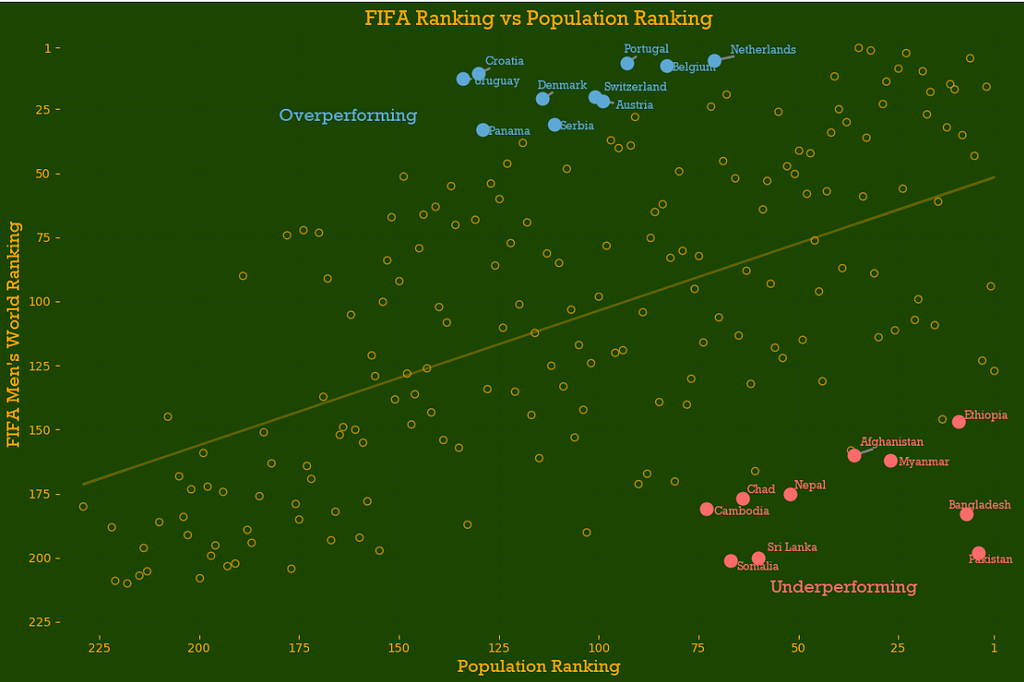
Similarly, Bangladesh and Sri Lanka — both economically established nations with sizeable outputs — also have their sporting focus elsewhere, notably cricket in which they are both world leaders. This helps explain their low FIFA rankings (183rd and 200th) are far below what would be expected from their GDP and population size. According to the linear regression model projected in the line below, these countries should be ranked 52nd and 81st, respectively.
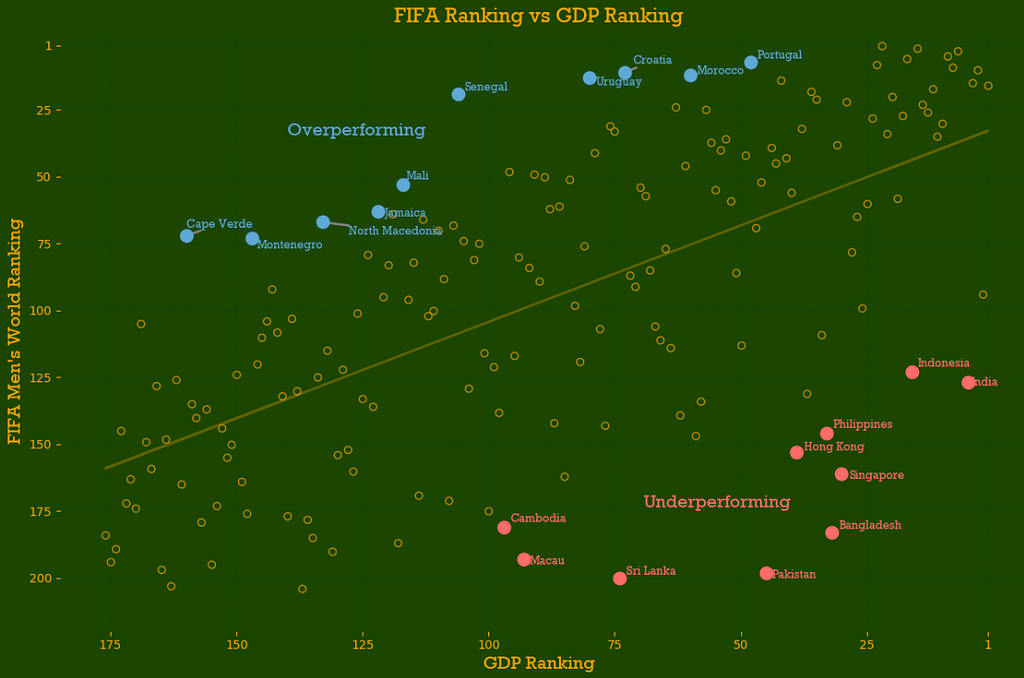
Uruguay is a great example of a footballing nation punching above its weight. Ranked 134th in population, it sits 13th in the FIFA Men's Rankings, thanks in part to its rich football heritage, including winning the first ever FIFA World Cup in 1930. Interestingly, its women's team ranks just 63rd, highlighting a gender disparity in sporting success. In both the population chart above and gender comparison charts below, Uruguay shines as an outlier — overperforming in men's football by significant margins.
The code for this analysis can be found in my GitHub repository