This season, FC Barcelona's bold defensive strategy has been central to their reclaiming of the La Liga title. At the core of this approach is a high defensive line, meticulously orchestrated to stifle opposition progression. The visualization below plots Offsides Conceded against Opposition Progressive Passing Distance, placing Barça in a distinct and extreme corner of the graph as they conceded by far the most offsides while simultaneously allowing the least progressive passing distance. This is not a coincidence but in fact the natural outcome of one of the most aggressive defensive setups in world football.
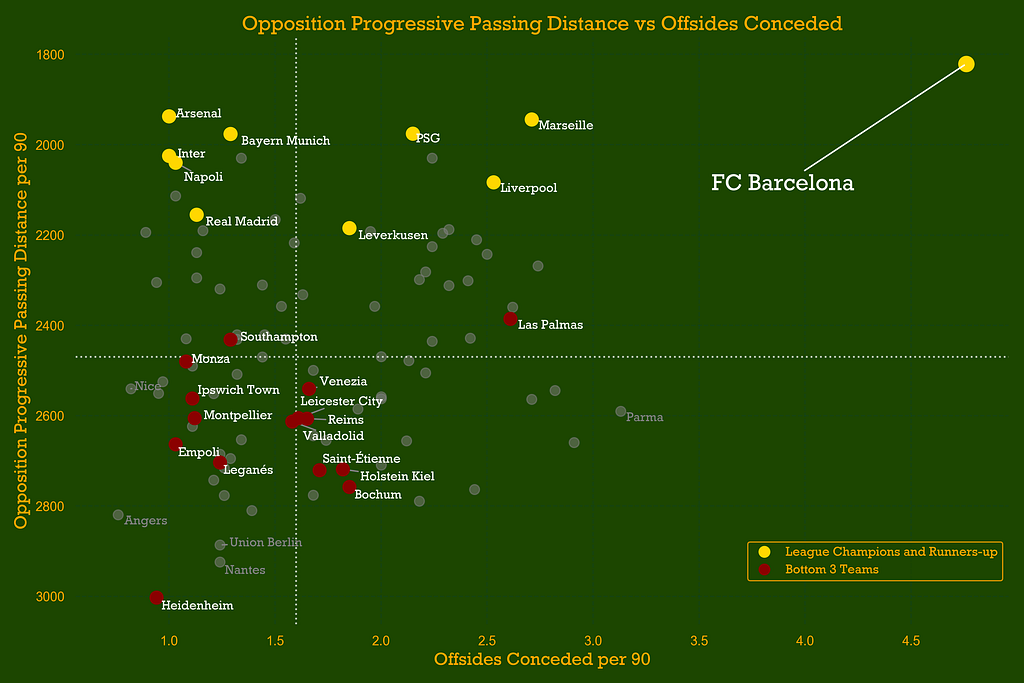
Anchored by the positioning and anticipation of Iñigo Martínez and Pau Cubarsí, Barcelona's high line compresses the pitch, forcing opponents into their own half and encouraging them to attempt risky balls over the top. The result is a flurry of offside calls as attackers struggle to time their runs behind a relentlessly disciplined back line. By stepping up with precision, Barça not only denies space but also disrupts rhythm, collapsing the time and room opponents need to construct meaningful attacks. Progressive passing distance, a key indicator of territorial gain, is dramatically reduced under this pressure.
Naturally, this strategy carries inherent risks. A high defensive line demands elite timing and communication, particularly from central defenders and the goalkeeper. When the long-term injury to first-choice keeper and captain Marc-André ter Stegen threatened the integrity of the system, manager Hansi Flick remained committed to his tactical principles. Emergency signing Wojciech Szczęsny rose to the occasion, helping the team secure an extraordinary 43 points from a possible 45 in the league. Even so, goalkeeping with so much space behind the defence inevitably invites moments of uncertainty, most memorably against Benfica, when Szczęsny collided with Alejandro Balde while charging out to intercept a ball played over the top.
When executed with the precision Barcelona have shown under Flick, the high line becomes a proactive defensive weapon. The high number of offsides conceded is not a sign of disorganisation, but a deliberate, repeatable outcome of a system designed to neutralise threats before they emerge. It is controlled through compression, and over the course of the season, it proved to be remarkably effective.
All data is sourced from FBREF.com. Find the code for this analysis on my Github